


What affects the cost of a website project (and what doesn’t)

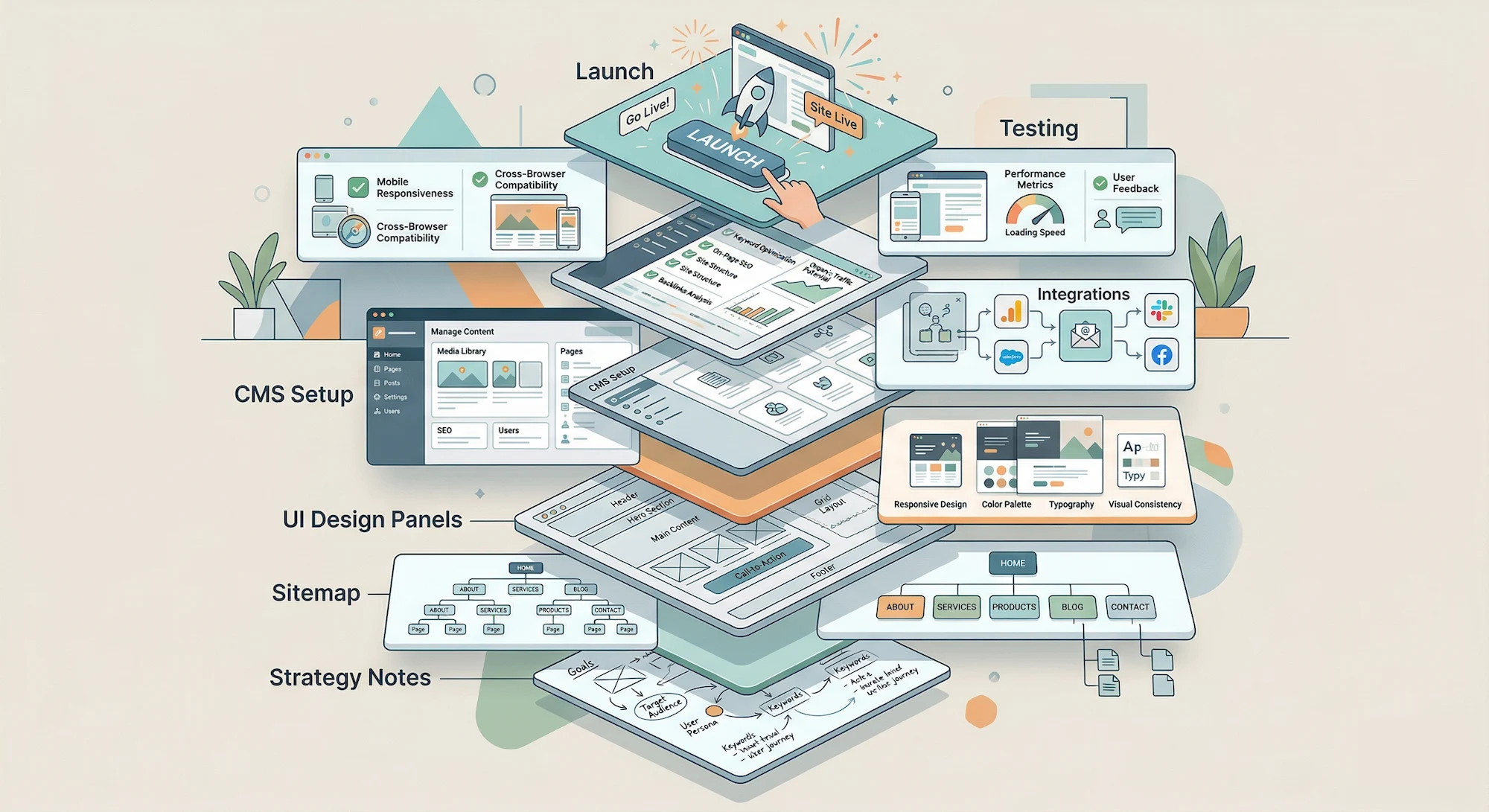
The cost of a professional website project is determined by a handful of structural factors: the number of unique page templates required, the complexity of the content management system, whether e‑commerce is involved, how much content needs to be created or structured, and the extent of integration with external tools. Many of the things people worry about most — visual complexity, total page count, minor copy changes after launch — have far less impact on cost than is generally assumed.
That short summary is accurate, but it’s not especially useful on its own. What tends to be more helpful is understanding why certain decisions affect the scope of a project and others don’t, because that understanding changes the way you approach the conversation with whoever ends up building your site.
The factors that genuinely shape scope
When we put together a proposal for a website project, the conversation rarely starts with how many pages the site needs. It starts with how many distinct page types are required, and what each of those pages has to accomplish.
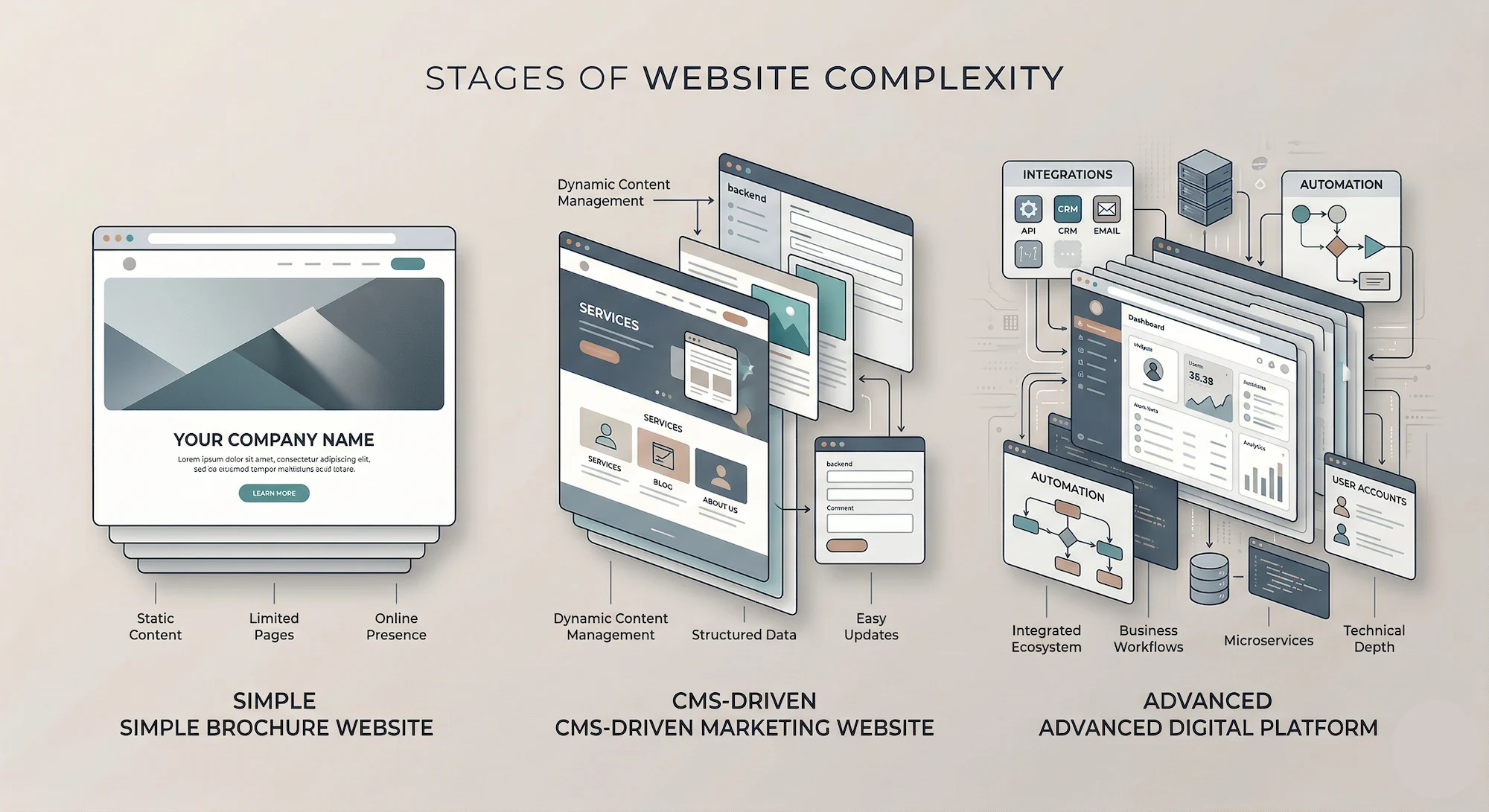
A five-page website where every page has a unique layout, its own content structure, and bespoke interactions is a more involved build than a twenty-page site built on three well-considered templates. Once a template has been designed, developed, tested across devices, and connected to the CMS properly, creating additional pages from it is comparatively fast. The template count is the structural driver, not the page count.
The second significant factor is CMS complexity. A straightforward blog with a handful of fields is one thing. A system where practitioners, services, locations, and conditions are all interlinked — where updating a single practitioner’s profile cascades to every service page they appear on — is an entirely different proposition. It isn’t harder in the sense of being confusing to use once it’s built, but it requires substantially more structural thinking during the planning phase and more careful implementation. The payoff is a platform the client’s team can manage confidently as the content grows, without needing developer involvement for every routine change.
E‑commerce introduces its own complexity. A Webflow–Shopify integration needs clean data flow between two platforms, considered product architecture, and deliberate decisions about where the brand experience ends and the checkout experience begins. If you're still working out which platform suits your business, our comparison of Webflow and WordPress covers the structural differences in detail.The integrations that cause problems are the ones where this boundary wasn’t properly thought through at the outset, and rectifying that after launch is invariably more costly than getting it right the first time.
Content readiness is the factor that catches most clients off guard. When copy, imagery, and brand assets are available at the start of the project, the build maintains momentum and the timeline holds. When they aren’t, and the project pauses while content is developed or gathered, that delay has a real cost on both sides. We build content planning into every engagement for exactly this reason, but it would be dishonest to pretend that client-side content delays aren’t the most common reason projects extend beyond their original timeline.
Integrations round out the picture. Connecting to a booking system, a CRM, an email platform, or a payment gateway each adds scope. Most individual integrations are manageable within a standard build. The cumulative effect of several together, however, can shift a project’s complexity meaningfully, and it’s better to surface that during scoping than to discover it mid-build.
The things that matter less than people assume
Visual complexity is perhaps the most misunderstood cost factor. A carefully considered, restrained design with strong typography, deliberate spacing, and refined interactions is not inherently more expensive to build than a site with heavy animation and decorative flourishes. In practice, it is often less expensive, because design restraint tends to produce cleaner, more maintainable code. The sites that cost more to build are the ones with structural complexity, not visual complexity.
Total page count is another common misconception. Once the templates exist, populating them with content is one of the faster parts of the process. A thirty-page site is not automatically twice the cost of a fifteen-page site. The question that matters is how many of those pages share a layout, and how complex each layout needs to be.
Post-launch adjustments — updating a paragraph, swapping an image, adding a new team member to a CMS collection — are the kinds of tasks that Webflow is specifically designed to make straightforward. They are part of the reason we build on the platform. They are not “extra work” in any meaningful sense; they are the system functioning as it was intended to.
Where most of the investment actually goes
If there is one thing worth understanding about website project cost, it is that the majority of the investment goes into decisions rather than decoration.
The most significant portion of any well-run project is the strategic work that happens before anything is designed: working through what the site needs to achieve, how content should be organised, which pages carry the most weight, and what the path from visitor to enquiry should look like. This is also the part of the process that saves the most money over the life of the site, because a website built on clear, well-considered decisions doesn’t need to be substantially rethought two years later when the business has moved on.
CMS architecture is the second largest investment. A well-structured CMS is entirely invisible to the person visiting the site, but it determines whether the client’s team can manage their own content with confidence or whether every routine change requires a support request. That investment in structure tends to pay for itself many times over in the first year alone.
Design and visual execution sit in the middle. They matter considerably — a site that doesn’t feel credible won’t build trust, regardless of how well it’s structured underneath — but the design phase is typically not the cost driver people expect.
Quality assurance, performance optimisation, accessibility, and SEO hygiene fill out the remainder. These are not optional additions. They are part of building the thing properly, and we include them because delivering a site that loads slowly, behaves unpredictably on mobile, or ignores basic accessibility isn’t something either of us is willing to put our names to.
Typical ranges, for context
We don’t publish fixed pricing, because every project is genuinely different and a figure without context isn’t particularly helpful to anyone. That said, ranges are useful for setting expectations, so here is roughly what professional Webflow projects tend to look like in Australia and New Zealand:
- A focused 5–10 page site for a service business, with bespoke design, CMS, and strong structural foundations: AUD $15,000–$30,000.
- A larger build with multiple content types, more complex CMS architecture, and custom interactions: AUD $30,000–$55,000+.
- A Webflow–Shopify integration with product architecture, brand pages, and e-commerce functionality: this varies considerably depending on catalogue size and integration complexity, but typically starts above $30,000.
These ranges reflect bespoke, premium builds — not templated or offshore work. They include strategy, design, development, QA, and launch support. Ongoing Website Evolution is scoped separately, and our Melbourne hiring guide covers costs, timelines, and process in greater depth if a more detailed breakdown would be useful.
Why the cost question benefits from context
When someone asks what a website project costs, what they are usually trying to determine is whether their budget is realistic for what they need. That is an entirely reasonable question, and one we are always happy to answer honestly during an initial conversation.
The answer only makes sense, though, in the context of what is being built and why. A $15,000 site with sound structure, manageable CMS, and room to evolve is a better investment than a $40,000 site that is over-engineered for the business’s actual needs. The objective is not to spend a particular amount; it is to direct the right amount toward the things that will matter most over the next three to five years.
That is why we scope every project individually and provide detailed proposals with clear line items before any work begins. No ambiguity, no hidden costs, and no pressure to proceed if it doesn’t feel right.
A realistic word on cheaper alternatives
It is worth acknowledging that websites can be built for considerably less than the ranges outlined above. Template-based builds, offshore development teams, and DIY platforms are all viable options, and for some businesses at certain stages, they may well be the appropriate choice.
The difference tends to become apparent six to twelve months after launch. A templated site begins to show its constraints as the business outgrows the original structure. An offshore build functions until something needs to change and there is nobody available who understands how it was put together. A DIY site looks reasonable in isolation until a potential client compares it with a competitor’s professionally built equivalent.
This is not to suggest that a premium build is the right answer in every situation. It is to point out that the cost of a website project is not confined to the initial build; it is the total cost of ownership over the next three to five years. That calculation tends to look quite different from the figure on the original invoice.
Common questions
How much does a Webflow website cost in Australia?
Most professional Webflow builds in Australia sit between AUD $15,000 and $55,000+, depending on the number of unique page templates, CMS complexity, and whether e‑commerce is involved. Template-based or offshore alternatives can cost less upfront, though the total cost of ownership over three to five years is often higher due to limitations, rebuilds, and ongoing developer dependency.
What is the single biggest factor in website project cost?
The number of unique page templates and the complexity of the content management system. A site with twenty pages built on three templates typically costs less than a site with eight pages that each require a completely different layout. The investment is concentrated in strategic thinking and CMS architecture, not visual decoration.
Should I invest in a premium website or start with something cheaper?
It depends on how central the website is to your business. If you are testing an idea or need a simple online presence while other priorities take precedence, a lower-cost option may be the sensible starting point. If your website needs to generate enquiries, support a growing team, or represent a brand that clients judge by its digital presence, investing in proper foundations tends to cost less over time than rebuilding every two to three years.
Why don’t you publish fixed pricing on your website?
Because every project is different, and a price without context does not help anyone make a considered decision. We provide detailed proposals with clear line items after understanding the scope of the project, so there are no surprises. We are happy to give honest guidance on whether your budget is realistic during an initial conversation — there is no obligation attached to that.
Does adding more pages to a website increase the cost significantly?
Less than most people expect. Once a page template has been designed and built, adding further pages that use it is one of the faster parts of the process. Cost is driven by how many unique layouts are required and how complex each one needs to be, not by the total number of pages on the site.
Worth a conversation?
If you are trying to work out what a website project might look like for your business, we are happy to have an initial conversation — no proposals, no obligation, just an honest assessment of scope, budget, and whether what you need aligns with what we do. Our FAQ covers more detail on how we approach projects, and the Melbourne hiring guide provides a more granular breakdown of costs and process.