



What Happens After a Website Launches? (And Why Most Agencies Disappear)

A website launch is an important milestone, but it's not where the real value is created. Businesses that invest in ongoing website improvement — updating content, refining performance, and adapting to changing needs — consistently see better long-term results than those that launch and leave. The first 30 days after launch require active monitoring and adjustment, and the months that follow determine whether a site stays effective or quietly becomes a liability.
The launch-day illusion
There is a particular kind of high that comes with launching a new website. Everything is fresh, the design looks sharp, the content is current, performance scores are green. Everyone involved gets to feel good about the thing they just made.
And then, gradually, nobody touches it for eight months.
This isn’t a criticism — it’s a pattern, and one that plays out with almost every business we’ve worked with over the years. The energy that goes into getting a site live is enormous. Once it’s done, teams exhale and move on to the next priority. The website quietly slips from “new thing we’re proud of” to “thing that exists in the background.”
The businesses that get the most from their websites are the ones that treat launch as the starting line rather than the finish. That distinction sounds like a cliché until you see the difference it makes over twelve months of real data and real decisions.
The first 30 days: what actually needs to happen
The first month after launch isn’t glamorous, but it matters more than most people realise. This is when you discover the things that testing didn’t catch — and every site has them.
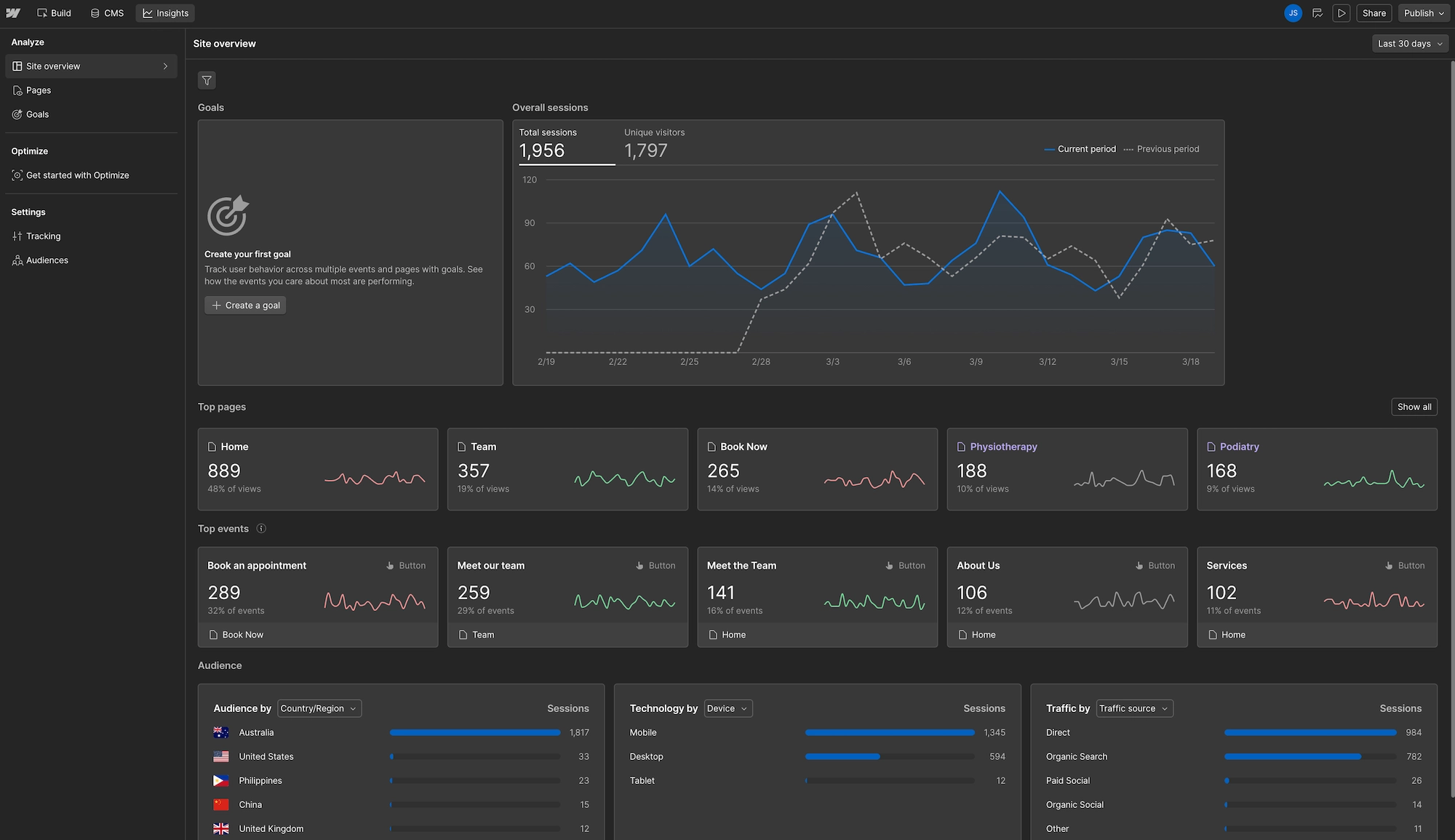
Monitor real user behaviour. Analytics data from actual visitors is different from what you assumed during the build. Which pages are people landing on? Where are they dropping off? Are they finding the content you thought was obvious? The first few weeks of real data almost always reveal something unexpected, and that something is usually worth acting on quickly.
Fix the small stuff. A form that behaves slightly differently on one mobile browser. A heading that wraps awkwardly at a particular screen width. An image that loads slowly on the connection speed your actual users have. None of these are catastrophic individually, but they compound. Catching them while the build is still fresh in everyone’s mind is significantly easier than returning to them six months later when context has been lost.
Confirm your technical foundations. Make sure Google Search Console is indexing pages correctly. Check that the sitemap is being crawled. Verify that redirects from any previous URLs are working. Test that forms are delivering submissions to the right place. These are the unglamorous checks that prevent you from discovering a problem three months in, when the damage has already been done and the trail has gone cold.
Let your team get comfortable with the CMS. The first month is when your team should be making their first real edits — not in a training session, but on actual content that matters to them. If they’re going to hit friction points with the editing experience, better to surface them now while there’s still access to the people who built the thing.
The 3–12 month reality
This is where most websites start to drift, and where the “launch and leave” model quietly fails.
Content goes stale. The service description that was carefully written at launch no longer reflects how the business actually talks about what it does. The team page is missing someone who started four months ago. The blog hasn’t been updated since launch week. None of these things feel urgent in isolation, but collectively they erode credibility in ways that are difficult to measure and easy to ignore. Visitors can sense when a website hasn’t been touched in a while — it’s the digital equivalent of a dusty shopfront with a “Grand Opening” banner still in the window.
Business priorities shift. Perhaps a new service has been added, or a particular offering has become the main revenue driver and deserves more prominent placement. Perhaps analytics have revealed that a page everyone assumed was secondary is actually where most enquiries originate. A website built around the business’s situation at launch doesn’t automatically adapt to the situation six months later, and the gap between the two grows wider with every passing quarter.
User behaviour tells you things the initial strategy couldn’t. With several months of analytics data, patterns emerge that were invisible during the planning phase. The page expected to perform well might have a high bounce rate. The blog post written as an afterthought might be generating the most organic traffic. This data is genuinely valuable — but only if someone is paying attention to it and prepared to act on what it reveals.
The technology moves on. Search engine algorithms evolve. Accessibility standards tighten. Browser capabilities change. AI-driven search becomes a factor in how people discover your business. A site that was technically sound at launch can fall behind on these fronts without anyone noticing — until it starts quietly affecting performance or rankings in ways that take real effort to diagnose.
The rebuild cycle
Here is the pattern we see repeatedly: a business invests significantly in a new website, launches it, maintains it minimally for two to three years, then finds themselves needing another significant investment to bring it back up to standard.
By that point, the site has usually drifted far enough from the business reality that a surface-level refresh isn’t sufficient — it needs a substantial rethink. Content needs rewriting. Structure needs revisiting. The design looks dated not because the original work was poor, but because the world moved on while the site didn’t. And the cost of addressing all of that at once is, unsurprisingly, much higher than it would have been to make smaller improvements along the way.
The logic is the same as building maintenance. Regular upkeep is boring and easy to defer — but it is dramatically cheaper than the renovation you’ll need if you leave things for five years and then wonder why the roof is leaking.
The alternative is what we call Website Evolution: ongoing, intentional improvement rather than periodic rebuilds. Smaller, considered changes on a regular rhythm — refining a page layout, updating content, improving performance, adding a section that addresses something the analytics data has surfaced. The site stays current, stays credible, and the total investment over time is typically lower than the boom-and-bust rebuild cycle.
What ongoing improvement actually looks like
“Ongoing website improvement” can sound vague if you haven’t seen it in practice, so it’s worth being specific about what it involves.
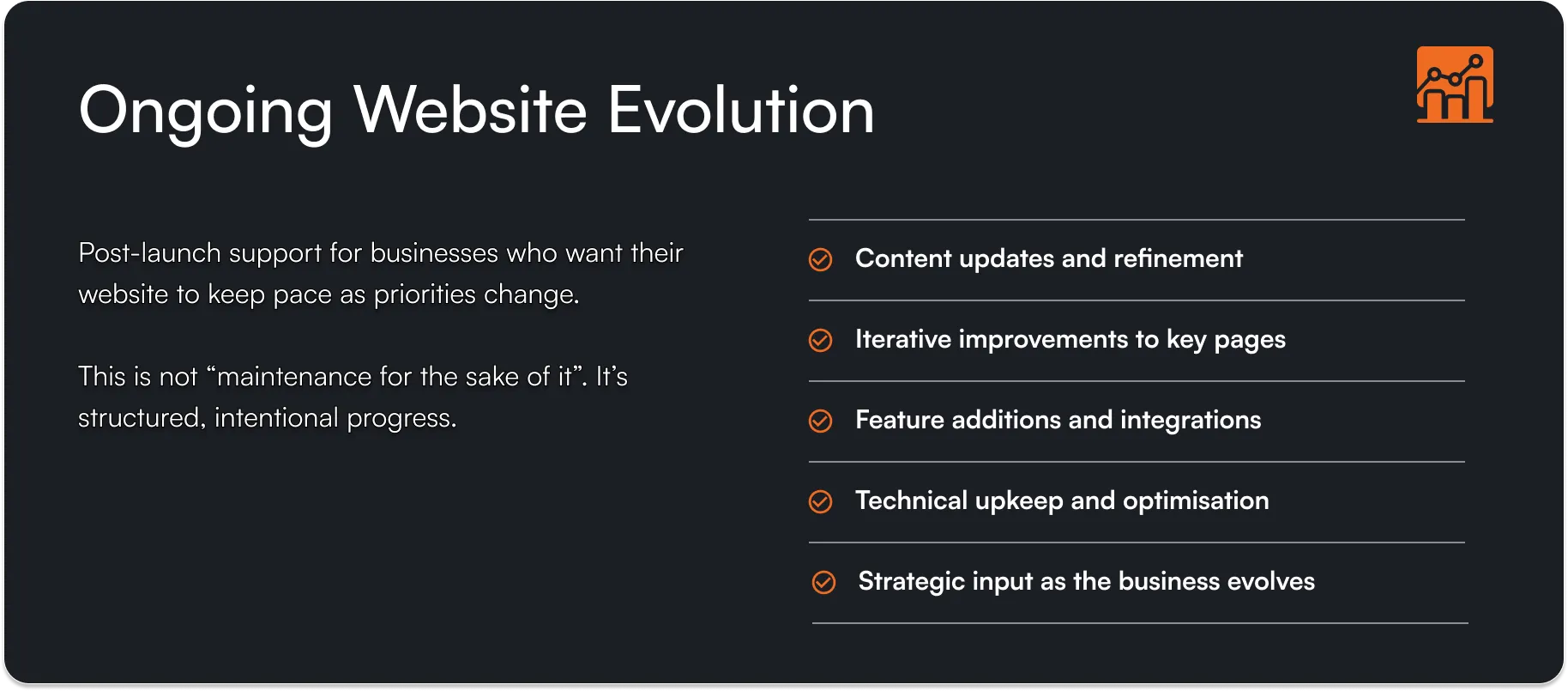
For the clients we work with through Website Evolution, a typical quarter might include some combination of the following:
Content refinements. Updating a service description to reflect how the business has genuinely evolved. Rewriting a page introduction that isn’t connecting with visitors the way it should. Adding a case study or testimonial that demonstrates recent work. Refreshing imagery that has started to feel dated. These changes keep the site aligned with the business as it actually operates — not as it operated eight months ago when the content was last written.
Structural improvements. Adding a new page for a service that has grown in importance. Restructuring navigation based on how people are actually using the site rather than how the team assumed they would. Improving the mobile experience on key conversion pages. Building out an FAQ section to address the questions that keep surfacing in sales conversations and could be answered before the first phone call happens.
Performance and technical work. Improving page load speeds. Updating meta descriptions and schema markup. Ensuring AEO readiness as search technology continues to evolve in directions that reward well-structured, authoritative content. Reviewing accessibility. These are the behind-the-scenes improvements that don’t produce dramatic before-and-after comparisons, but directly affect how the site performs in search and how users experience it.
Strategic conversations. Reviewing analytics data together. Discussing what’s working and what isn’t with the honesty that comes from both parties having invested in the outcome. Planning the next quarter’s priorities based on what the data actually shows, rather than what anyone assumed would happen.
The point isn’t volume — it’s intentionality. Some quarters involve more work than others. The important thing is that someone with the context and skill to make good decisions is looking at the site regularly, rather than waiting for something to visibly break before paying attention.
What to look for in ongoing support
Whether you work with us or someone else entirely, there are a few things worth looking for in any ongoing website partner. This advice is genuinely useful regardless of who you choose, and I’d rather you make a good decision than simply make a decision that involves us.
Proactive, not just reactive. A good partner should be identifying opportunities and potential problems before you notice them. If the only time you hear from them is when you raise an issue, that’s maintenance — not evolution. The distinction matters because one keeps things from breaking while the other actively makes them better.
Transparent about what’s worth doing. Not every improvement is equal, and a trustworthy partner will tell you when something isn’t worth the investment rather than simply agreeing to whatever you suggest. The willingness to say “that’s not where I’d spend your budget this quarter” is a useful signal of someone who has your actual interests in mind.
Understands your business, not just your website. The best website decisions come from understanding what the business is trying to achieve, not just what the site looks like. If your partner isn’t asking about your broader goals, they’re optimising in a vacuum, and the results will reflect that.
We’ve seen marketing agencies sell the whole kitchen sink on retainer, without truly understanding the business or the build. Headaches inevitably follow.
Clear about what it costs. No ambiguity, no surprise invoices, no scope that expands without conversation. You should know what you’re getting and what it costs before any work begins, and the relationship should be structured around your actual needs rather than a one-size-fits-all retainer that bills regardless of value delivered.
The honest question
Not every business needs ongoing website support, and it would be disingenuous to suggest otherwise. If your site is primarily a digital brochure that rarely changes, and you’re comfortable managing the basics yourself, that’s a perfectly valid approach — especially on Webflow, where the technical maintenance burden is minimal by design.
But if your website directly affects revenue, credibility, or client acquisition — and if your business is evolving in ways that the site should reflect — then leaving it untouched after launch is leaving value on the table. Not in the abstract, motivational-poster sense. In the measurable, “this page is costing you enquiries” sense.
The question isn’t whether you can afford ongoing improvement. It’s whether you can afford not to have it.
If you’d like to understand what Website Evolution could look like for your business — or if you simply want to talk through whether your current site is still serving you as well as it should — we’re happy to have that conversation.
Common questions
How long after launch should I start making changes to my website?
Most sites benefit from active attention within the first 30 days — monitoring analytics, fixing small issues, and making initial content adjustments based on real user behaviour rather than assumptions. After that, a regular quarterly rhythm of planned improvements is a sensible baseline for most businesses, though the specifics depend on how quickly the business itself is changing.
What’s the difference between website maintenance and Website Evolution?
Maintenance keeps things running — security updates, uptime monitoring, fixing things when they break. Website Evolution is about making the site actively better over time — refining content, improving key pages, adapting to business changes, and building on what the analytics data reveals. One is reactive and necessary. The other is intentional and where the real value tends to accumulate.
Can I manage my Webflow site myself after launch?
Yes — and we set up every site to make that straightforward. Your team can update text, images, and blog content through the CMS without a developer. For more structural changes — new layouts, added functionality, or design updates — that’s where a developer typically needs to step back in. The goal is that your team handles the day-to-day confidently, and a professional handles the things that benefit from deeper expertise.
How much does ongoing website support cost?
It depends on the scope and frequency, and any honest answer has to start there. Our Website Evolution engagements are structured around your actual needs — some clients work with us monthly, others quarterly. We’ll give you a clear picture of what’s involved and what it costs before anything begins, and the structure adapts as your needs change. Get in touch for a conversation about what makes sense for your situation.
Discuss your project
If you’d like to understand what Website Evolution could look like for your business — or if you simply want to talk through whether your current site is still serving you as well as it should — we’re happy to have that conversation.